
Ancient Shan Tuyet Tea from Xin Chai, Lai Chau – A Mountainous Island in the Northwest Forest Amidst the Misty Mountains

Amidst the cold clouds of the Northwest mountains, where altitudes exceed 1300 meters and are shrouded in fog year-round, lies a special ancient tea region that Vietnamese tea lovers still speak of as a treasure of the wilderness. This is the Xin Chai Ancient Shan Tuyet Tea region, located in Xin Chai and Ta Leng villages, Khong Lao commune, Lai Chau province – where centuries-old tea trees silently grow deep in the forest, absorbing the essence of the earth and sky to create a tea with a unique flavor found nowhere else.
For the Mong ethnic people here, Shan Tuyet tea is not just an agricultural product. It is the memory of their ancestors, the soul of the mountains and forests, and a source of livelihood that has been intertwined with generations for hundreds of years.
1. A rare, pristine ancient tea-growing region nestled amidst the vast forests of Northwest Vietnam.

The villages of Xin Chai and Ta Leng are located near the high mountains of northern Vietnam, where the climate is cool year-round, the forest soil is rich in natural minerals, and fog covers the area almost all year round. These harsh yet pristine natural conditions have created an extremely rare region of ancient *Shan Tuyet* trees.
Currently, this area still has more than 600 ancient Shan Tuyet tea trees, over 300 years old, growing naturally in the old-growth forest. Many trees are 4-7 meters tall, their trunks covered in moss, and their canopies spread wide, standing as living witnesses to the history of this border region.

- The tea buds are large, plump, and covered with a thick layer of white downy hairs.
- High natural mineral content thanks to the pristine forest soil.
- The cold climate and fog help the tea accumulate deep, lasting flavors.
- The tea has an authentic mountain and forest aroma, with a deep, lingering sweet aftertaste.
Those who have tasted Shan Tuyet Xin Chai tea can easily sense its distinctiveness: the initial light, refreshing astringency quickly transforms into a deep, rich sweetness, and the aroma is subtle, reminiscent of forest wood, mountain honey, and morning dew.
2. The Mong people and tea plants – A centuries-old bond.

100% of the people in Xin Chai and Ta Leng villages are ethnic Mong people. Life here still preserves many original traditional cultural features: the sound of the Mong flute echoing through the mountains and forests, colorful hand-embroidered dresses, spring festivals, pao throwing, flute dancing, and customs deeply connected to nature.
Amidst this way of life, the Shan Snow tea plant has become an inseparable part of the local culture. From the early morning, when clouds still blanket the mountain slopes, the villagers carry baskets on their backs and head into the forest to pick the tender tea buds covered in snow-like down. The harvesting is done entirely by hand to preserve the natural quality of the ancient tea trees.
For the Mong people here, tea is not simply a beverage. Tea is a bond within the community, a story of the mountains and forests, and a source of pride in their borderland homeland.
3. Sung A Pang – A young man preserving the soul of Shan Tuyet Xin Chai tea.

Born in 1990, Sung A Pang is a model son of the Mong ethnic group in Xin Chai village. Witnessing his fellow villagers having to sell fresh tea buds to traders at low prices for many years, he was always concerned about how to make the Shan Tuyet tea of his homeland more valuable.
In 2021, he and his fellow villagers established the Xin Chải Cooperative, directly purchasing fresh tea leaves and processing them right in the village into various specialty teas such as:
- Shan Tuyet Green Tea
- Shan Tuyet Red Tea
- Shan Tuyet White Tea
- Shan Xue Raw Pu-erh Tea
From someone who only knew how to make traditional green tea, Mr. Pằng diligently learned and participated in many training courses on tea processing techniques, agricultural product exhibitions, and trade promotion programs at the Lai Châu provincial and national levels.
After several years of development, the Shan Tuyet Xin Chai tea brand gradually became known to many tea enthusiasts both domestically and internationally. In 2024, the cooperative’s Ancient Shan Tuyet Green Tea product received OCOP 3-star certification, becoming a source of pride not only for Xin Chai village but also for the entire Shan Tuyet tea region of Lai Chau.
4. A nearly organic tea growing area nestled amidst natural mountains and forests.
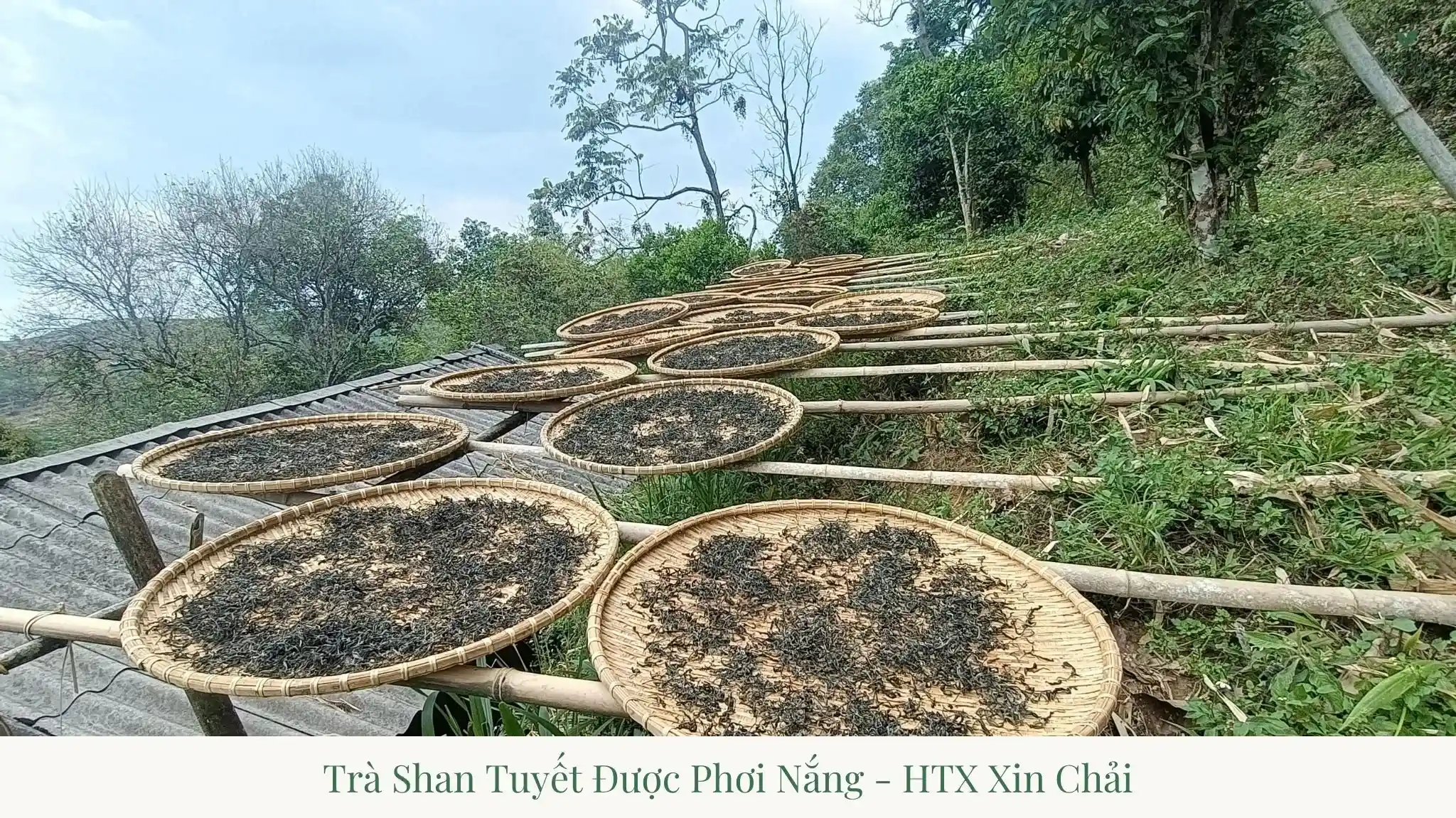
The Shan Tuyet Xin Chai tea growing area has achieved VietGAP certification. However, the reality is even more special. Most of the ancient tea trees grow completely naturally in the forest, with almost no chemical intervention.
From 2014 to the present, the cooperative and local people have continued to cultivate and plant approximately 6,000–7,000 new native Shan Tuyet tea trees to preserve the rare genetic resources of this tea-growing region.
What is most valuable is that the people here do not view tea cultivation merely as a short-term economic benefit. They see it as an asset for future generations, a part of their culture that needs to be preserved.
“When tea connoisseurs enjoy a cup of Shan Tuyet Xin Chai tea, they are also feeling the soul of the Mong people in the northwestern border region – sincere, simple, and full of love for their homeland.”
5. The rare and unique flavors of the border region.

Thanks to its unique climate and rare ancient tea trees, Shan Tuyet Xin Chai tea possesses a very distinct character:
- A deep aroma, with hints of forest and natural sweetness.
- The tea liquor is either clear yellow or amber depending on the type of tea.
- A mild, refreshing astringency with a lingering sweetness that lasts for hours.
- A feeling of thick water, rich in mountain minerals.
It is this unique flavor that has made it a favorite among tea enthusiasts in Hanoi, Ho Chi Minh City, and even international visitors. Some Shan Tuyet Xin Chai tea products have been indirectly introduced to the US and European markets through Vietnamese tea lovers.
However, due to the limited yield from these rare, ancient tea trees, the cooperative often lacks sufficient tea to meet all orders or participate in major exhibitions.
6. Preserving the soul of Vietnamese tea in the border regions of our homeland.

Amidst the era of industrialization and the waves of mass-market tea production, the ancient Shan Tuyet tea region of Xin Chai still stands as a pristine part of Vietnamese tea.
In that remote border region, the simple Hmong people still diligently preserve the tea plants passed down from their ancestors. They preserve not just a type of plant, but also a cultural memory, a spirit of persistent hard work, and a love for their homeland.
Each cup of Shan Tuyet Xin Chai tea is therefore more than just a beverage. It is the taste of the Northwest mountains and forests, the breath of the clouds, the sincerity of the highlanders, and also a source of pride in Vietnam’s precious indigenous values.
Conclude

Xin Chai Ancient Shan Tuyet Tea is not simply a highland specialty. It is a living heritage of the Northwest mountains and forests, the culmination of pristine nature and the culture of the Mong people in the border region of our country.
Amidst the vast, mist-shrouded forests of Lai Chau, ancient tea trees silently thrive for hundreds of years, reflecting the enduring spirit of the local people. And perhaps the most precious thing that Shan Tuyet Xin Chai tea offers is not just its flavor – but the feeling of touching a very deep part of the Vietnamese soul.